Are you passionate about becoming a teacher or advancing your career in education? The College of Education, Gindiri (COE Gindiri) in Plateau State will officially open admissions portal for the 2026/2027 academic session. This is your chance to pursue Degree, Nigeria Certificate in Education (NCE), or Professional Diploma in Education (PDE) programmes in a reputable state-owned institution known for quality teacher training.
Located in the serene town of Gindiri (near Mangu, Plateau State), the college offers a conducive learning environment with experienced lecturers, affordable fees, and strong focus on producing competent educators for Nigeria’s schools. Whether you’re a fresh JAMB candidate, Direct Entry applicant, or someone seeking professional certification, this guide will cover everything you need: eligibility, cut-off marks, available programmes, step-by-step application process, tips to succeed, and more.
Why Choose College of Education Gindiri?
COE Gindiri stands out among colleges of education in Nigeria for several reasons:
- Affordable tuition compared to private institutions.
- Diverse programmes across arts, sciences, languages, social sciences, and vocational education.
- Peaceful campus environment in Plateau State, ideal for focused studies.
- Strong emphasis on practical teaching skills, preparing graduates for Teachers Registration Council of Nigeria (TRCN) certification and jobs in primary/secondary schools.
- Affiliation with the University of Jos and Ahmadu Bello University for degree programmes to allow seamless progression to higher qualifications.
Many alumni secure teaching positions in public and private schools across Nigeria, making it a solid choice for education career starters.
Available Programmes at College of Education, Gindiri
The College of Education, Gindiri (COE Gindiri) provides comprehensive teacher education programmes tailored to meet Nigeria’s growing need for qualified educators. These offerings span foundational teacher training to advanced degree levels, with a strong emphasis on practical skills, subject expertise, and professional development.
For the 2026/2027 academic session, programmes are categorized as follows:
1. Degree Programmes
COE Gindiri’s Bachelor of Education (B.Ed.) and related degree programmes are run in affiliation with the University of Jos (Unijos), a reputable federal university in Plateau State. This partnership ensures high academic standards, with degrees awarded by the University of Jos upon successful completion. These are typically four-year programmes but it shorter for direct entry candidates.
Degree programmes suit candidates seeking advanced teaching roles in secondary schools, educational leadership positions, or pathways to postgraduate studies (e.g., M.Ed. or PhD).
Key Degree Programmes:
- B.Ed. Early Childhood Education
- B.Ed. Primary Education Studies
- B.Ed. Guidance and Counseling
- B.Ed. Special Education
- B.Ed. Educational Management
- B.Ed. Human Kinetics / Physical and Health Education
- B.Sc.Ed. Biology Education
- B.Sc.Ed. Chemistry Education
- B.Sc.Ed. Mathematics Education
- B.Sc.Ed. Physics Education
- B.Sc.Ed. Geography Education
- B.Sc.Ed. Economics Education
- B.A.Ed. English Education
- B.A.Ed. Religious Studies Education (Christian Religious Studies)
- B.A.Ed. French Education
- B.A.Ed. History & International Studies Education
- Additional approved areas: Library and Information Science, Technical Education, and others (up to 19–23 programmes in recent approvals).
Candidates need 180+ JAMB score and must have chosen COE Gindiri as their first choice or change their institution via JAMB CAPS.
2. NCE Programmes (Nigeria Certificate in Education – Main Teacher Training Qualification)
The Nigeria Certificate in Education (NCE) remains the core programme at COE Gindiri, serving as the primary qualification for teaching in Nigerian primary and junior secondary schools (recognized by the Teachers Registration Council of Nigeria – TRCN). This three-year programme combines two teaching subjects with foundational education courses, pedagogy, micro-teaching, and extensive practicum.
NCE is an excellent entry point for school leavers or candidates with JAMB scores of 100+, offering quick access to the teaching profession at an affordable cost.
NCE Programmes are grouped across major schools with popular course combinations:
- School of Arts and Social Sciences:
- Christian Religious Studies / Social Studies
- Economics / Social Studies
- Geography / Social Studies
- History / Social Studies
- Political Science / Social Studies
- Theatre Arts / English
- School of Sciences:
- Biology / Chemistry
- Biology / Geography
- Biology / Mathematics
- Biology / Physics
- Chemistry / Mathematics
- Integrated Science (Double Major)
- Mathematics / Computer Science
- Physics / Mathematics
- School of Vocational and Technical Education:
- Agricultural Science (Double Major)
- Business Education (Double Major)
- Home Economics (Double Major)
- Technical Education
- School of Languages:
- English / Various combinations
- Arabic / Islamic Studies
- School of Early Child Care and Primary Education:
- Early Childhood Care Education
- Primary Education Studies
(Over 30 NCE programmes are fully accredited by the National Commission for Colleges of Education – NCCE. Direct/non-JAMB entry is available via the Bursary for ₦5,000.)
3. Professional Diploma in Education (PDE) – For Graduates Wanting Teaching Qualifications
The Professional Diploma in Education (PDE) is a one-year (full-time) or flexible part-time postgraduate programme for bachelor’s degree holders in non-education fields who want to acquire formal teaching credentials. It covers essential areas like educational psychology, teaching methods, curriculum development, and supervised teaching practice—leading to TRCN certification.
This programme is ideal for career switchers, professionals in other sectors, or graduates aiming to teach while leveraging their existing qualifications.
PDE Highlights:
- Open to any recognized university graduate.
- Focuses on practical pedagogy and classroom readiness.
- Forms are available now—apply via the college portal.
All programmes include hands-on teaching practice in partner schools, preparing graduates for immediate employment or further advancement. With recent NCCE accreditations and strong affiliations, COE Gindiri continues to deliver quality education that meets national standards.
Admission Requirements & Cut-Off Marks at College of Education, Gindiri
Gaining admission into College of Education, Gindiri (COE Gindiri) for the 2026/2027 academic session is straightforward if you meet the key eligibility criteria. The college follows national guidelines from JAMB and the National Commission for Colleges of Education (NCCE), but sets its own minimum JAMB UTME scores for competitive programmes.
All applicants must have at least 5 O’Level credits (including English Language and Mathematics) in relevant subjects, obtained in not more than two sittings (WAEC, NECO, NABTEB, or equivalent). Results must be uploaded to JAMB CAPS early to avoid delays during verification.
Here’s a clear breakdown by programme:
| Programme | Minimum JAMB UTME Score | Key Admission Requirements | Additional Notes |
|---|---|---|---|
| Degree Programmes (B.Ed./B.Sc.Ed./B.A.Ed. – Affiliated with University of Jos) | 180 and above | – 5 O’Level credits in relevant subjects (including English & Math) – Relevant subject combination for chosen course – Change institution to COE Gindiri on JAMB portal if not already chosen – Direct Entry (DE): NCE, A-Level, or equivalent qualifications | Higher scores improve chances for competitive courses like Sciences or Education Management. It enables affiliated University to give you admission. |
| NCE Programmes (Nigeria Certificate in Education) | 100 and above | – 5 O’Level credits in relevant subjects (incl. English & Math) – Appropriate subject combination for chosen NCE course | National minimum for colleges of education is 100; COE Gindiri aligns with this for accessibility. |
| Non-JAMB / Direct NCE | Not required | – 5 O’Level credits (incl. English & Math) – Purchase form directly at the Bursary Department on campus | Ideal for candidates who missed JAMB or prefer direct entry; fee is typically ₦5,000 (non-refundable). |
| Professional Diploma in Education (PDE) | Not applicable (postgraduate) | – Bachelor’s degree (HND or equivalent) from a recognized institution in any field – Interest in teaching/professional certification – Relevant supporting documents (transcripts, NYSC certificate if applicable) | Aimed at graduates seeking TRCN certification to teach; no JAMB required. |
Important Explanations & Tips:
- JAMB Cut-Off Context: The national JAMB policy for colleges of education is a minimum of 100 for NCE programmes. COE Gindiri raises it to 180 for Degree programmes due to affiliation standards with University of Jos to maintain quality and competitiveness. Meeting the minimum does not guarantee admission. Factors like O’Level grades, subject combination, number of applicants, and any screening often aggregate-based play a role.
- O’Level Specifics: Credits must match your chosen programme. Awaiting results are allowed but must be uploaded before final admission.
- Direct Entry for Degree: If you have NCE or equivalent, apply via JAMB DE portal first, then complete COE Gindiri’s process.
- Common Pitfalls to Avoid:
- Not changing institution on JAMB portal.
- Incorrect subject combination during UTME registration.
- Failing to upload O’Level results to CAPS promptly.
- No Separate Post-UTME Exam? Sometimes, the college uses JAMB score + O’Level aggregate for screening without conducting physical exam.
- Competitive Edge: Aim higher than the minimum (e.g., 200+ for Degree) for popular courses like Biology Education or English Education.
How to Apply: Step-by-Step Guide
The process is straightforward and mostly online.
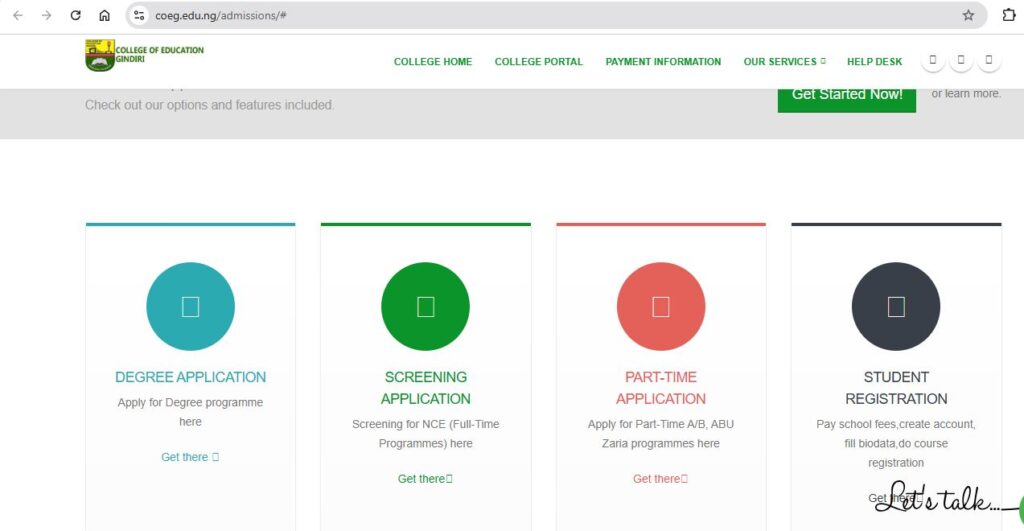
- Visit the official portal: Go to the admissions section coeg.edu.ng/admissions/.
- Create an account or log in (if returning).
- Select your programme (Degree, NCE, or PDE).
- Fill the online application form: Provide personal details, JAMB registration number, O’Level results, and course choices.
- Upload required documents: Passport photograph, JAMB result slip, O’Level certificates, birth certificate, LGA identification, etc. (scans in clear format).
- Pay the application fee of ₦5,000 via online or bank).
- Submit and print acknowledgement slip: Keep this safe as it serves as proof.
- For non-JAMB NCE applicants: Visit the Bursary Department on campus, pay ₦5,000, and collect your receipt/form.
- Change of institution (if needed): Do this first on the JAMB CAPS before applying.
Important Dates & Deadlines
Forms are currently on sale but Post UTME portal will be officially opened in August 2026.
Required Documents
- JAMB result slip/printout
- O’Level results (WAEC/NECO)
- Birth certificate/declaration of age
- Local Government Area certificate
- Recent passport photographs
- Payment receipt
- Change of institution printout (if applicable)
Keep originals safe for possible physical verification.
Why This Opportunity Matters
With Nigeria’s growing demand for qualified teachers, graduating from COE Gindiri positions you well for stable jobs, further studies, or even entrepreneurship in education.
Frequently Asked Questions (FAQs)
1. Is Post-UTME screening required? Most often, admission is based on JAMB score + O’Level aggregate; some sessions include online screening.
2. Can I apply if Gindiri wasn’t my first choice? Yes—change your institution to COE Gindiri on JAMB portal first.
3. What if my JAMB score is below the cut-off? Consider NCE (lower threshold) or non-JAMB direct entry.
4. Are hostels available? Yes—apply during registration; limited spaces, so early applicants have advantage.
5. How do I check admission status? Visit coeg.edu.ng/portal/welcome/admissionresult later.
6. Contact for help? Email: info@coeg.edu.ng | Phone: +2349091055292 | Address: Gindiri, Mangu, Plateau State.
Final Thoughts
Don’t wait, some admission forms for College of Education Gindiri 2026/2027 are open now! Head to the official portal, apply correctly, and take the first step toward a rewarding teaching career.
Have questions? Drop them in the comments below. Share this post with friends hunting for admission options.

My name is Abdulrazaq Yahaya, also known as Razach. I studied Electrical and Electronic Engineering at the Federal Polytechnic Idah, Kogi State.
I created this blog, Razach Telecoms, to share helpful and practical guides on admissions, scholarships, and job opportunities. These are the exact resources I struggled to find when I needed them the most. My goal is to make the process easier for students and young professionals by providing the information I wish I had during my own journey.