Preparing for the JAMB 2026 UTME can feel overwhelming, but the official JAMB syllabus is your best weapon. The syllabus tells you exactly what JAMB will test you on without guessing or wasting time reading irrelevant topics.
The 2026 JAMB syllabus is now available on the official Integrated Brochure & Syllabus System (IBASS) portal. It covers all subjects, including newly emphasized areas like Computer Studies and Physical & Health Education as optional subjects.
Why you must use the JAMB syllabus:
- It shows the exact topics and sub-topics for each subject.
- It includes clear objectives of what you are expected to know.
- It lists recommended textbooks to avoid using the wrong books.
- Studying with the syllabus helps you focus and score higher.
In this guide today, you will find:
- How to download the official syllabus
- Detailed breakdown for major subjects
- Recommended textbooks for each subject
- Smart study tips and common mistakes to avoid
Let’s get started!
How to Access/Download the Official JAMB 2026 Syllabus (Step-by-Step)
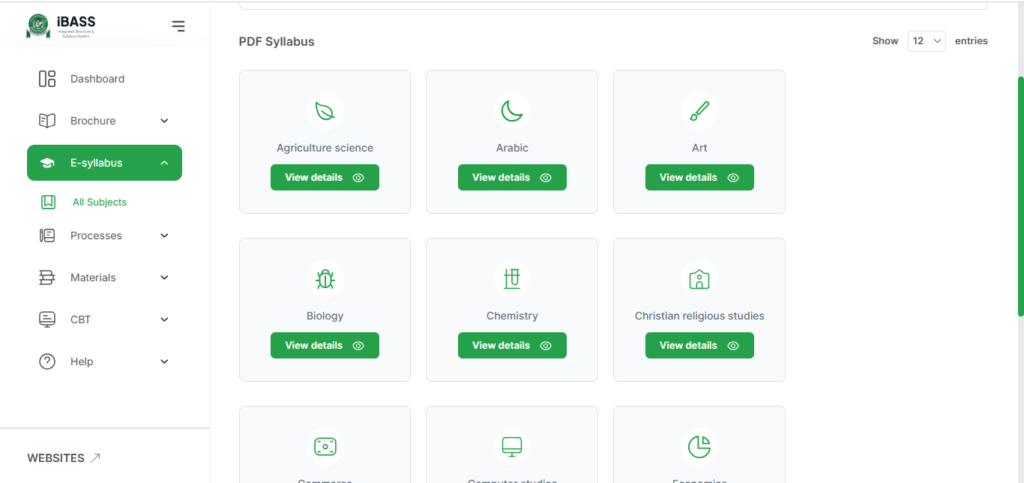
- Visit the official JAMB IBASS portal: https://ibass.jamb.gov.ng/
- Click on E-Syllabus (or look for the menu and select it).
- You will see a list of all subjects with icons.
- Click on any subject you need (e.g., English Language, Physics).
- Read the topics online or click the Download PDF button at the top.
Compulsory Subjects Breakdown
1. Use of English (Compulsory for All Candidates)
Objectives: To test candidates’ ability to communicate effectively in English through comprehension, grammar, lexis, structure, and oral English.
Main Sections & Key Topics:
- Section A: Comprehension Passages — Reading for main ideas, inferences, and vocabulary in context.
- Section B: Lexis and Structure — Synonyms, antonyms, sentence interpretation, grammar rules (tenses, concord, prepositions, etc.).
- Section C: Oral Forms — Vowels, consonants, stress patterns, intonation, rhymes.
- Common errors in English usage.
Most Important/Repeated Areas: Comprehension passages, nearest in meaning questions, grammar (concord, tenses), and stress/intonation.
Recommended Textbooks for JAMB 2026 English:
- New Oxford Secondary English Course (for all classes)
- Doses of Grammar by M.A. Adedimeji
- Practice in Spoken English for Nigerian Students
- English Grammar by P.C. Wren & H. Martin (or any good secondary school grammar book)
- Oral English by J. O. Olatoye or similar
Study Tip: Practice at least 2 comprehension passages daily and master 50 common synonyms/antonyms.
2. Mathematics (Compulsory for Most Science, Engineering & Some Commercial Courses)
Key Topics (Major Areas):
- Number and Numeration (fractions, decimals, indices, logarithms, surds)
- Algebra (quadratic equations, inequalities, progressions, matrices)
- Geometry and Trigonometry (angles, polygons, circle theorems, sine/cosine rules)
- Calculus (differentiation and integration basics)
- Statistics and Probability
- Sets, Logic, and Binary operations
Repeated Hot Topics: Quadratic equations, simultaneous equations, trigonometry, statistics (mean, median, mode), and permutation/combination.
Recommended Textbooks:
- New General Mathematics for Senior Secondary Schools (Books 1–3) by Channon et al.
- Essential Mathematics by A.J.S. Uluocha
- Mathematics for Senior Secondary Schools by Egbe et al.
- Further Mathematics by A. Godspower
Study Tip: Solve at least 20 past questions daily. Focus on speed and accuracy since it’s CBT.
Science Subjects
3. Physics
Major Topics:
- Mechanics (motion, force, energy, work, power)
- Heat and Thermodynamics
- Waves and Optics (light, sound, reflection, refraction)
- Electricity and Magnetism (current, circuits, electromagnetic induction)
- Modern Physics (atomic structure, radioactivity, electronics)
Hot Areas: Simple harmonic motion, gas laws, electric field, lenses/mirrors, and radioactivity.
Recommended Textbooks:
- New School Physics by M.N. Anyakoha
- Senior Secondary Physics by P.N. Okeke
- Essential Physics by B. Olumuyiwa
- Comprehensive Physics for Senior Secondary Schools
4. Chemistry
Key Topics:
- Atomic structure and periodic table
- Chemical bonding and molecular structure
- Stoichiometry and chemical equations
- States of matter (gases, liquids, solids)
- Acids, bases and salts
- Organic chemistry (hydrocarbons, alcohols, functional groups)
- Environmental chemistry and industry
Repeated Topics: Balancing equations, periodic trends, organic nomenclature, electrolysis, and rates of reaction.
Recommended Textbooks:
- New School Chemistry by Osei Yaw Ababio
- Chemistry for Senior Secondary Schools by Bajah et al.
- Practical Chemistry by G. O. Ojokuku
- Essential Chemistry for Senior Secondary Schools
5. Biology
Main Topics:
- Organization of life (cells, tissues, organs)
- Ecology and conservation
- Nutrition, respiration, excretion, reproduction
- Heredity and variation (genetics, Mendel’s laws)
- Evolution and adaptation
- Diseases and their control
Hot Areas: Ecology (food chains, nutrient cycles), genetics, human physiology, and plant/animal reproduction.
Recommended Textbooks:
- Modern Biology by S.T. Ramalingam (or any senior secondary version)
- Essential Biology by M.C. Michael
- Biology for Senior Secondary Schools by Ndu et al.
- Comprehensive Biology by J. O. O. Ogunniyi
Art & Commercial Subjects
6. Government
Key Topics:
- Basic concepts in government (authority, power, sovereignty)
- Forms of government (democracy, dictatorship, etc.)
- Political ideologies
- Constitution and constitutionalism
- Organs of government (legislature, executive, judiciary)
- Nigerian government and politics (colonial era to present)
- International organizations (AU, UN, ECOWAS)
Recommended Textbooks:
- Government for Senior Secondary Schools by C.C. Dibie
- Essential Government by C. C. Onah
- Comprehensive Government by J. U. Anyaele
7. Economics
Major Topics:
- Basic economic concepts (scarcity, choice, opportunity cost)
- Demand and supply
- Theory of production and cost
- Money, banking and financial institutions
- National income
- International trade and balance of payments
- Economic development and planning in Nigeria
Recommended Textbooks:
- Economics for Senior Secondary Schools by A. A. Aderinto et al.
- Essential Economics by C. E. Ande
- Comprehensive Economics by J. U. Anyaele
8. Literature in English
Key Areas:
- Literary terms and principles
- Drama (tragedy, comedy, elements)
- Poetry (types, devices, appreciation)
- Prose (fiction and non-fiction)
Recommended Textbooks:
- An Introduction to Literature by O. B. O. Nwankwo
- Essential Literary Terms
Other Popular Subjects (Brief):
- CRS/IRS: Biblical/Qur’anic knowledge, moral teachings, prophets, etc.
- Geography: Map reading, climate, settlement, economic activities.
- Commerce: Business units, trade, finance, marketing.
Newly Emphasized / Optional Subjects
- Computer Studies: Evolution of computing, hardware/software, programming basics, computer applications, word processing, spreadsheets, internet and safety.
- Physical and Health Education (PHE): Foundations of PE, human anatomy, sports, health education, nutrition, first aid.
General Tips for Using the JAMB 2026 Syllabus Effectively
- Download and print your four subjects’ syllabuses.
- Tick off topics as you cover them.
- Combine syllabus + recommended textbooks + JAMB past questions (at least 10 years).
- Create a realistic timetable
- Practice CBT format regularly
- Avoid reading outside the syllabus to stop wasting your time.
Common Mistakes to Avoid:
- Relying only on one textbook.
- Ignoring objectives in the syllabus.
- Starting late or skipping English.
- Using outdated materials.
FAQs About JAMB 2026 Syllabus
Is the JAMB 2026 syllabus different from 2025?
The core topics remain largely the same, but always check the official IBASS portal for any minor updates.
Can I use 2025 textbooks for 2026?
Yes, the recommended textbooks are usually stable. Focus more on understanding concepts than the year of publication.
How many subjects do I need?
Four subjects: Use of English + three others relevant to your course.
Where can I get free JAMB past questions?
Many reliable education sites and apps offer them. Combine with your syllabus.
Is the syllabus enough to pass JAMB?
No. Use it as your guide, but pair it with consistent practice and recommended books.
Conclusion
The JAMB 2026 syllabus is the foundation for smart preparation. If you study according to it, use the right textbooks, and practice past questions daily, scoring 250–300+ becomes very achievable.
Start today by downloading your subjects from https://ibass.jamb.gov.ng/e-syllabus and begin ticking off topics.
Share this guide with your friends preparing for JAMB 2026. Drop your questions or the subject you find most difficult in the comment section below. I will try to answer them.

My name is Abdulrazaq Yahaya, also known as Razach. I studied Electrical and Electronic Engineering at the Federal Polytechnic Idah, Kogi State.
I created this blog, Razach Telecoms, to share helpful and practical guides on admissions, scholarships, and job opportunities. These are the exact resources I struggled to find when I needed them the most. My goal is to make the process easier for students and young professionals by providing the information I wish I had during my own journey.