One of the most frequently asked questions after the JAMB 2026 UTME is: “What is the cut-off mark for my course and school?”
JAMB sets a minimum benchmark (also called the national minimum tolerable score), but individual universities set their own departmental cut-off marks, which are usually much higher, especially for competitive courses like Medicine, Law, Engineering, and Nursing.
In this guide, you will know:
- The difference between JAMB minimum cut-off and departmental cut-off
- Official minimum cut-off marks for 2026/2027
- Typical cut-off ranges for federal, state, and private universities
- What score you realistically need for popular courses
- What to do if your score is below the cut-off
The final departmental cut-offs are released by each university.
What is a JAMB Cut-Off Mark?
The JAMB cut-off mark is the minimum UTME score a candidate must obtain to be eligible for admission consideration into a particular institution or course.
There are two types:
- JAMB Minimum Benchmark — Set nationally during the JAMB Policy Meeting. JAMB 2026 cut-off mark is 100.
- Departmental Cut-Off — Set by each university for specific courses. This is almost always higher than the JAMB minimum.
Scoring above the JAMB minimum only makes you eligible for Post-UTME/screening. It does not guarantee admission.
Official JAMB Minimum Cut-Off Marks for 2026/2027 Admission
Based on the pattern from recent policy meetings (including 2025/2026), JAMB has consistently set the following minimum benchmarks:
- Universities (Federal, State & Private): 150
- Colleges of Nursing Sciences: 140
- Polytechnics & Monotechnics: 100
- Colleges of Education: 100
These are the lowest scores any institution is allowed to accept. Most universities set their own institutional cut-off between 160 and 200+, and competitive departments go much higher.
Federal Universities Cut-Off Marks
Federal universities are generally more competitive. Here are realistic ranges for 2026/2027:
| Category | Typical Institutional Cut-Off | Competitive Courses (e.g., Medicine, Law) |
|---|---|---|
| Highly Competitive (UNILAG, UI, UNN, ABU, OAU) | 200 – 250+ | 250 – 280+ |
| Major Federal Universities | 180 – 220 | 220 – 270 |
| Newer/less competitive Federal | 160 – 190 | 200 – 240 |
Examples of Popular Federal Universities (approximate):
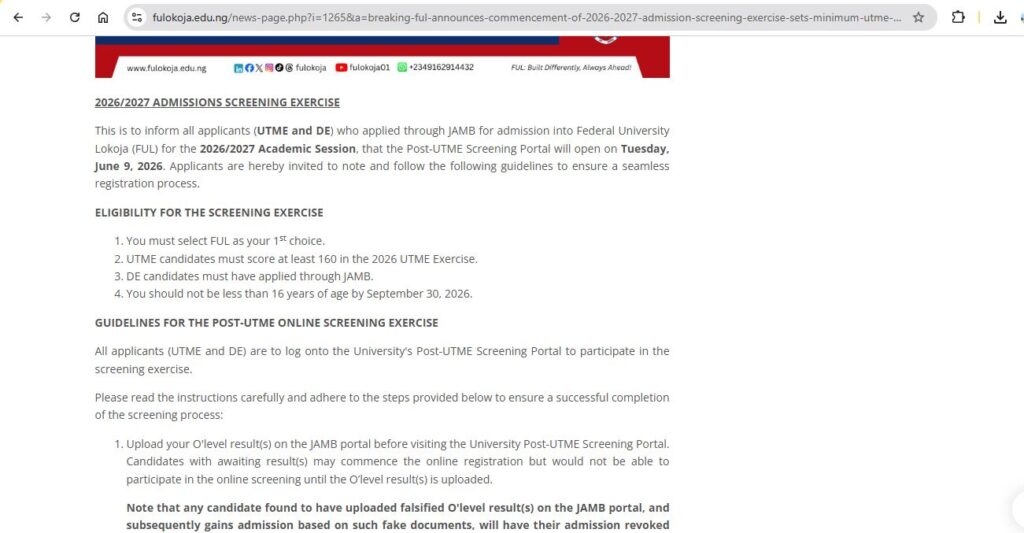
- University of Lagos (UNILAG), University of Ibadan (UI), UNN: Often 200+
- Ahmadu Bello University (ABU), University of Ilorin: 180–200+
- Many others start from 160–180 for less competitive courses.
State Universities Cut-Off Marks (Typical Ranges)
State universities vary widely depending on location and demand:
- Highly competitive ones (e.g., LASU, UNIOSUN, RSU): 180 – 220+
- Moderate ones: 160 – 200
- Newer or less subscribed: 150 – 180
Many state universities are slightly more flexible than top federal ones, but popular courses still require high scores.
Private Universities Cut-Off Marks
Private universities generally have lower and more flexible cut-offs:
- Most private universities: 150 – 180
- Some top private ones (e.g., Covenant, Babcock, Afe Babalola): 180 – 220+
- Many accept candidates with 150–170 for several courses, making them a good option for moderate scorers.
Private universities often have faster admission processes and fewer candidates competing for slots.
Departmental Cut-Off Marks for Popular Courses (Realistic 2026/2027 Expectations)
| Course | Realistic Score Range Needed |
|---|---|
| Medicine & Surgery, Dentistry | 250 – 290+ |
| Law | 230 – 270+ |
| Engineering (especially Petroleum, Electrical, Mechanical) | 220 – 260+ |
| Pharmacy, Nursing | 220 – 260+ |
| Accounting, Business Admin | 200 – 240 |
| Computer Science | 210 – 250 |
| Mass Communication | 200 – 240 |
| Education Courses | 160 – 200 |
| Agriculture, Arts & Humanities | 160 – 210 |
These are approximate ranges. Actual departmental cut-offs depend on the performance of candidates in that year and the number of available slots.
What to Do If Your Score is Below the Cut-Off
- Change of Course/Institution — Switch to a course or school with a lower cut-off (very common and effective).
- Consider Polytechnics or Colleges of Education — Many accept 100–140 and offer ND or NCE programmes that can lead to university via Direct Entry.
- Pre-degree / Remedial / JUPEB / IJMB — These foundation programmes can lead to 100-level or 200-level admission.
- Private Universities — Many have flexible admission and good scholarship opportunities.
- Prepare for Post-UTME Strongly — Some schools use aggregate (JAMB + Post-UTME + O’level) — a strong Post-UTME can compensate for a borderline JAMB score.
Important Tips for 2026/2027 Admission
- The JAMB minimum (150) is just the starting point — aim higher for better chances.
- Upload your O’level results on CAPS early.
- Monitor your chosen school’s website for Post-UTME dates and specific departmental cut-offs.
- Consider catchment area and educationally less developed states (ELDS) advantages in some federal universities.
- Avoid paying agents who promise “guaranteed admission” above cut-off — it’s usually a scam.
FAQs on JAMB Cut-Off Marks 2026/2027
Is 150 enough to gain admission into any university?
No. It only makes you eligible. Most universities and courses require higher scores.
Do all federal universities have the same cut-off?
No. JAMB sets the minimum, but each university sets its own (usually higher).
Can a private university accept below 150?
No. They must respect the national minimum benchmark.
When will exact departmental cut-offs be released?
Usually after Post-UTME screening by each institution (between August and October).
Does Post-UTME affect the cut-off?
Yes — many schools calculate an aggregate score combining JAMB, Post-UTME, and sometimes O’level grades.
Conclusion
Understanding JAMB cut-off marks for 2026/2027 helps you set realistic goals. While the national minimum for universities is 150, aim for 200+ if you want competitive courses in good universities. For moderate scores (150–190), consider less competitive courses, state/private universities, or polytechnics as viable options.
Your admission chances depend on more than just your JAMB score — strong O’level results, timely change of course (if needed), and good performance in Post-UTME all matter.
Share this guide with your friends preparing for JAMB 2026. Stay focused and take the right steps. Admission is still very possible for you!
Related Posts:
- How to Check JAMB 2026 Result & What to Do If You Score Low
- JAMB 2026 Change of Course/Institution: When, How & Best Strategies
- JAMB CAPS 2026: Step-by-Step Guide to Admission Process

My name is Abdulrazaq Yahaya, also known as Razach. I studied Electrical and Electronic Engineering at the Federal Polytechnic Idah, Kogi State.
I created this blog, Razach Telecoms, to share helpful and practical guides on admissions, scholarships, and job opportunities. These are the exact resources I struggled to find when I needed them the most. My goal is to make the process easier for students and young professionals by providing the information I wish I had during my own journey.